Tuesday, February 28, 2023

The Right Moses H. Clark

 So, Moses H. Clark has been the furthest back Clark in Margaret's line, but I see some genealogies go back further, but I believe there is more than one Moses H. Clark and there has been some mistaken merging. Thus, I am going to try to ID all the information folks have used and see what I end up with.

At the core, is what I have on Geni (with Charles Knowles Clark being the sone of Mary Clark; Mary Wolcott being the daughter of Lucy Clark). However, I picked up this John and Jane Clark along the way, and don't trust it.

Birth:circa 1806
Vermont, United States 
Death:July 04, 1879 (68-77)
Southampton, Hampshire County, MA, United States 
Place of Burial:Pine Hill Cemetery, Westfield, Hampden County, MA, United States
Immediate Family:

Son of John Clark and Jane Clark
Husband of Mary Clark and Lucy Clark
Father of Charles Knowles Clark and Mary Wolcott

A. Starting with Charles Knowles Clark, for whom we are certain. [Family Search KLNY-WHJ]

1. His grave:
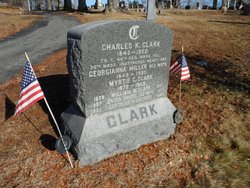
1842-1902.

2. His marriage record says he was born in Ohio and his parents were "Moses and Mary"

3. The 1880 census says both parents were born in Ohio.
 
4. The 1900 census says he was born in October 1842 and both parents were born in Ohio (but since all his children's line say their father--that is Charles Knowles, himself--was born in Massachusetts, we know not a lot of care is taken with these).

His 1902 death record says he was born in Guilford, Ohio, and that his parents were "Moses Clark" and "Mary Miller", giving no birthplace for his father, and Westfield, Mass., for his mother.

B. Moses H. Clark [Family Search ID LT97-PVL] has 11 sources, so not duplicating the above, these are:

1. His marriage to Mary Miller in the Westfield books (photo 743):


Just gives their names; no other information.

2. The 1850 census for Southwick, Mass shows:


Thus, a Moses H. born around 1806 in Vermont, an Alonzo A. born around 1836 in Massachusetts, what appears to be a Charles E. born around 1842 in Ohio, and a Susan born around 1779 in Connecticut. [By one genealogy, Alonzo and Charles E. are sons of Moses (and Mary) and Susan is Moses's mother.] Family Search ID LT97-PVL is given to this "Charles E." with no other sources.

3. The 1859 marriage of Alonzo Clark:


Showing an Alonzo of Westfield born around 1835 in Baltimore, Maryland, being the son of Moses H. Clark.

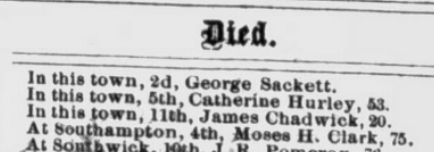
4. An 1879 death record showing a Moses H. Clark dying in July 1879, born around July 1806. See also this, from Page  3 of Western Hampden Times and Westfield News-Letter, published in Westfield, Massachusetts on Wednesday, July 16th, 1879:


5. A 1903 death record for Alonzo N. Clark, showing his birth around 1935 in Guilford, Ohio, to Moses Clark (no birthplace given) and Mary Miller (born in Westfield).

C. Moses H. Clark [Family Search ID MNKR-BHN] has only one source--have merged with B.

1. Feb. 19, 1851, marriage to Lucy Halladay (image from Ancestry):


Shows Moses H., whip-maker, born around 1806 in Southwick to John & Jane (Clark).

(2). Feb. 12, 1893 death of Lucy Halladay Clark cites Moses H. Clark as her husband.

(3) 1855 Massachusetts census:


Shows Moses H.  born around 1805 in Massachusetts and married to Lucy with Charles, born around 1841, in Ohio, and Mary, born around 1852, in Massachusetts.

(4) 1860 US census shows:


Moses H. as lash cutter, born in Vermont around 1806; Charles cigar box maker, born in Ohio, around 1842.

(5) Moses H. Clark grave:


Shows Moses dates as 1805-1879.

[Note Mary Clark Wolcott not engraved on here.]


Wednesday, February 16, 2022

Susie Cronin and her daughter, and the Sacketts and the Cronins

Dabbling in genealogy is one of the big uses of the Internet. However, unlike some other Internet wondering/wandering, one is very much restricted when relying on free sources of information. Over the years, one can find some vendors charging for things that are discoverable elsewhere, but if you really want to find things without running down city halls and libraries and newspaper archives all over the country (or the world!), you have to put down some money.

Over the past few years I have used subscriptions to genealogical and newspaper archives to build (slowly) family trees for both myself and my wife, making connections that were not otherwise passed down to us. In my wife's case, there has been one consistent mystery that we have occasionally tried to pin down without much success. Recently, Ancestry.com offered free access to its birth, death, and marriage records, which inspired me to try once again. This time, we appear to have gotten closer to some sort of story we can tell ourselves.

The starting point to all this is Margaret's paternal grandmother. Her birth origins were basically a family secret, though her grandchildren learned a few things: that her mother's name was named Susie Cronin, that she was raised by an aunt, that there was an important "Uncle Ownie," and that her birth father was a Sackett (specifically, according to one or her grandchildren, one Seymour Sackett). That's it.

Below is the story that I think we can tell now, as well as links to the historical record that lets us tell this story.

The "Other" Gertrude Sackett

Telling the Story of the Sacketts: the "Other" Gertrude Sackett

When the internet search began for the story of Susan Cronin and Gertrude Sackett, I thought we had "found" Gertrude Sackett, thinking that a close birth record was hers, and then linking her with another woman who had a liaison (and then married and divorced Seymour Sackett). However, as I continued to dig deeper, I decided that this was an "other" Gertrude Sackett (her half-sister, as presumably born of the same father). 

As the Sackett family site mentions, there was some confusion about this Gertrude Sackett's birth as it was recorded twice, once in Greenfield, MA, under a different name, and once in Cambridge, MA (after the fact). In either case, she was born before her mother and Seymour Arthur Sackett were married. A second daughter (Bertha) was born a few years later.

Don't know where Mary lived before her divorce (need to check City Directories in Connecticut when access to MyHeritage for 1890s).

From Ancestry.com, we learn that she married, had one son, and died in Bridgeport in 1967.

The Historical Record

Following is an itemized list of each of the documents or records I have come across in this investigation.

1. Registration of birth of "Emily" illegitimate female child of Seymour A. Sackett (sewing machine salesman) and Mary A. Norwood, Greenfield, July 16, 1887:


2. Registration in Cambridge, Massachusetts, in January 24, 1888, of birth of "Gertrude Adella Sackett" on July 16, 1887 in Greenfield, child of Seymour A. (agent) and Mary Elizabeth.


3. According to Sackett Family Association genealogical information on Seymour Austin Sackett, "He married second in Boston, Massachusetts, on 16 August 1887, Mary Elizabeth Norwood, daughter of Emery Norwood and Emily ___."     In addition,

After Seymour's death, Mary returned to New Haven, Connecticut, and was listed there in the 1897 city directory. According to Seymour's newspaper obituaries, he and Mary were divorced. These reports also state that he and Mary had two daughters. There are two records of a daughter born in Greenfield, Massachusetts, on 16 July 1887, one for Gertrude Adella in the Cambridge, Massachusetts, birth register, and one for Emily in the Greenfield register. It would be unlikely that twin daughters were not registered together and this would suggest that Gertrude and Emily were the same. Alternatively, if there were two daughters, it is possible that an error was made in recording the date of birth in one of the registers (both registers would have been written up some months later, the Greenfield register being dated February 1888 while the Cambridge register is undated).
4. Report from New Haven Daily Morning Journal and Carrier, September 28, 1895: "Mary E. Sackett was granted a divorce from her husband, Seymour A. Sackett" and "was also awarded the custody of two minor children." They were reported married on August 17, 1887.


5. Clipping from New Haven Daily Morning Journal and Carrier, July 15, 1896. Report of death of Seymour A. Sackett, on July 14, 1896. "He leaves a divorced second wife with two young daughters in New Haven".


6. Long story from New Haven Daily Morning Journal and Carrier, October 16, 1896about annual donation day at New Haven Orphan Asylum, mentioning that Gertrude Sackett did a recitation of "A Wonderful Trick" and that Bertha Sackett did a recitation of "The Reason Why" and won a prize of $1.

7. In 1897 New Haven City Directory, Mary Sackett is shown as a dressmaker and widow of Seymour Sackett:


8. Re-marriage to Edwin Balbier, from Morning Journal and Courier Friday, Aug 27, 1897 New Haven, CT Page 4:


9. 1900 census. [Census taker clearly transposed names of daughters and step-daughters from birth years and places.] Gertrude Sackett (as corrected, born in Massachusetts in July 1887) and Bertha Sackett living with Mary E. Balbier (and husband and two young daughters) in New Haven:

In 1910 census, Gertrude and Bertha have taken the Balbier name.

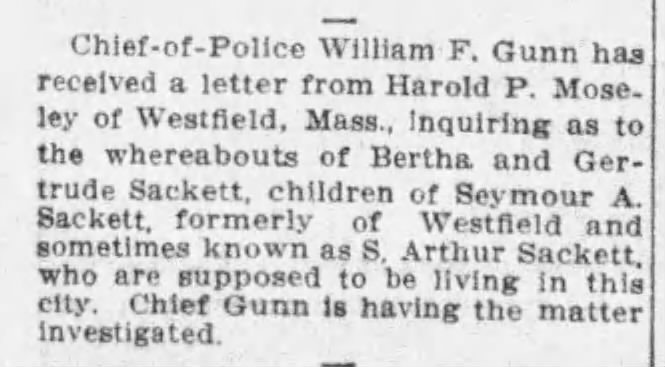
10. Clipping from Hartford Courant of March 3, 1910 about search for "Bertha and Gertrude Sackett, children of Seymour A. Sackett":


[Moseley was an attorney for the banks in Westfield, and also, according to obituary in Williams College,  "was deeply interested in the work for children of the Shurtleff mission to the children of the destitute. Of that organization he was president of the board of trustees."

Ellen Shattuck was Seymour Sackett's sister.

11. Ancestry.com facts of "Gertrude Adella Sackett Balbier"


Saturday, November 6, 2021

Ant and Bee: Bryan Ward Filling in the Picture

 When I started my search for Angela Banner a number of years ago, I was thwarted in my attempts to find out any information about the illustrator of the Ant and Bee books. This became even more frustrating when they started republishing the Ant and Bee books with truncated text and absurdly simplistic new illustrations. I would periodically wonder and wander again with no luck. However, I was urged on again when someone commented on my first post about having a Bryan Ward illustration and wanting to know more about him .... so the quest resumed, with great success this time!

Saturday, July 17, 2021

Theo von Brockhusen

 The beginning of a collection of links to paintings and information available on the Internet about Theo von Brockhusen.

Tuesday, February 2, 2021

Döberitz Gazette: Life at the Döberitz Prisoner of War Camp (WWI)

I used to have a website that I was planning to use to capture information about the Döberitz prison camp, since I had a copy of the second issued of the Döberitz Gazette, but I let it lapse. Thus, I am going to use this just to hold what I find.

Ant and Bee Lovers: Sighting and Citings on the Web

Given my interests in discovering more about Angela Banner and in wondering why new editions of her books are so bowdlerized, I thought it would be fun just to search and see what other scraps of food there are on the Internet for Ant and Bee lovers.

So, just browsing and finding:

Saturday, June 6, 2020

The Tale of a Cloth: Fortresses Facing Germany during World War I

Today's (this week's? turned out to be this year's!) wondering stems from trying to figure out what the map to the right is. Unlike what one may expect on a quick glance, it is not a map of Europe, but mostly north central Europe: eastern Germany, western Russia, and northern Austria-Hungary. In addition, the big bold-faced names are not those (with some exceptions) of major European cities. So what is it?

It is part of of what had been a fairly sizable collection of World War I materials saved by my great aunt. So, although undated, I have always known that it as some World War I German thing. In deciding to unburden ourselves of more stuff, I needed to figure out finally what the map is all about, so this is where I wandered.

The facts: the map is made of some sort of line, and it measures 16 1/2" x 16 1/2" (42 cm square). In looking at closely, I see that there is both a key (for distance) at the top and (perhaps) a title: the word "Festungen". So first things first, is the Google translate which gives me "Forts"; in parallel, Wikipedia takes me to Fortification. 

This lists fortresses (Festungen) in existence in eastern Germany, western Russia, and northern Austria-Hungary, presumably at the beginning of the war. Undated, published by Verlag Sander & Gronau, Hamburg.

So now that I can see that each of the symbols denotes a fortress, my wandering takes me to each of them (roughly going from North to South) on the map. The big question, however, will still be why this map and who was it for!


Tuesday, April 14, 2020

My First Driving Lessons

Another clipping from a scrapbook kept by mother brings back much fonder memories--learning street signs and how to navigate. I cannot remember if there are photographs of us, but I believe there may be, but will have to add them later (if and when I find them). 

This is a story from the U.S. Armed Forces newspaper, The Stars and Stripes, from September 5, 1958. My first Googling was to see if these were available online, and it turns out that they are, but for a fee. However, without buying in, I was able to capture a slightly buggy OCR transcription, so I didn't have to type it all:


Monday, April 13, 2020

NIghtmares Revisited... or a Trip to Bad Canstatt

Over a year from my last wandering! Today's was started by finding this clipping in a scrapbook of my mother's that I am disassembling to preserve what matters most. But, what was this clipping? One of the "failures" of my education has been not learning German, so I have to resort to Google Translate to start this search. While I didn't type it all in, I did get enough from the beginning:

For the carnival parade on Sunday
Traffic orders from the police headquarters
During the carnival procession in Bad Canstatt on Sunday, February 1, like the police headquarters, around 1:30 p.m. to 3:30 p.m. The Brunnenstrasse between Wilhelmstrasse and Schmiddener Strasse, Hofener Strasse ...
OK, more street closings and a map. I have no idea what my mother intended by saving this, but yikes it brought me back in time ... to a time when I had a recurrent nightmare brought on my attending a parade. Well, this was obviously the parade.


Tuesday, January 22, 2019

The Great Northern Hotel (London version)

So we just came home from a very nice trip to London, where we stayed at the Great Northern Hotel, which got me interested in its history and set me wandering/wondering on Google. However, I quickly discovered that simple searching for "great northern hotel" reveals that there were many buildings of this name, not just the one by St. Pancras and King's Cross in London! Thus, I am pairing this post with another one about OTHER "Great Northern Hotels."

The GNH website only gave a short bit about its history:
When the Great Northern Hotel first opened its doors in 1854, the passengers of London flocked. The hotel stood at the centre of London’s revolutionary new age of steam. Guests made the Great Northern Hotel a glamorous destination in central London and a stylish point of departure. 
Now magnificently renovated, the Great Northern Hotel guarantees the glorious glamour of its iconic past is central once again to the King’s Cross St Pancras basin. Lewis Cubitt, great architect of Victorian London, crafted this hotel to catch the eye: its slender curve of robust brick still a bold stamp on a busy landscape.
And I wanted to know more, not just about its renovation, but of how the original hotel appeared and how life was lived in it.  So the following satisfies some of my wander/wonder lust!


The Great Northern Hotels (NOT in London)

As mentioned in the parallel post, our recent stay at the Great Northern Hotel in London had sent me wandering/wondering in Google and led me to a great many other Great Northern Hotels, prompting me to gather together links to all the OTHER "Great Northern Hotels" not in London.

These are organized by location:

Chicag0
New York City
Twin Peaks
Other

Saturday, May 19, 2018

How Many Corners Are There? Seven Corners, Four Corners, and More Corners

So, as we drove past Seven Corners (Virginia) yesterday, I asked something which I don't remember pondering before--after over 40 years living here--where did it get its name? And then, further pondered--after then thinking of Four Corners--how many other numbered geographic "Corners" are there? My wife mentioned remembering a Five Corners growing up in Connecticut, but that's as far as we got. This seemed to call for some wondering.

The first question was easily answered. The Wikipedia article tells us that "[t]he change of place name [formerly Fort Buffalo] in the 1950s came about due to the construction of Lee Memorial Boulevard, now known as Arlington Boulevard (U.S. Route 50). The construction of Route 50 caused the formation of a seven cornered intersection—or did until the mouth of Wilson Boulevard was rerouted slightly to avoid all those roadways converging on a single point."  Googling then led me to the follow clear image:


So What About Other Numbered Corners?


Monday, May 22, 2017

Presentation of Manchester Free Trade Hall Relic to City of Leningrad


Among the papers I found recently in a file folder related to the 1964 settlement of the estate of my grandmother Mina Magdalena Jonas,  were the newspaper clipping and two letters. I had no prior knowledge of this. What is amusing is that the clipping, without the letters, would have been very mysterious, as my grandmother is not mentioned by name in the clipping.
Newspaper clipping
Letter from Leonard C. Howitt to
M.M. Jonas, Feb. 7, 1956


Letter from Philip P. Dingle  to
M.M. Jonas, Feb. 29, 1956

However, the accompanying letters make it clear that my grandmother had saved the day by working with the Manchester City Architect to provide the Russian translation so clearly desired. Since this blog is about Internet wandering/wondering, I wondered what this was all about, and about the people involved.


Sunday, February 19, 2017

"Dr. F. C. Toy": Another Attempted Internet Resurrection of a Life (updated)

So are, this is a failure. Lots of little pieces, but no real biographical information. Not even what the initials stand for, leave alone birth or death dates.

In my mother's memoirs, she writes that she worked for the:
British Cotton Industry Research Association (Shirley Institute) as an Information Officer, doing mainly abstracts from the current literature for our own publication and they were also reprinted in The Journal of the Textile Institute. ... It was a job I really liked; my boss was Dr.Withers, an elderly man, a real teddy bear, his glasses halfway down his nose. ... We were what was known as “Scientific Civil Service”, i.e., we had the best of two worlds: the privileges of the Civil Service (good pension plan etc.) and of Academia (very generous leave time!). ... The Institute also encouraged further education: if you took courses that were approved, you could leave two hours before school started (all evening courses). At first I took just statistics and economics, but then they approved my finishing the degree course, that’s how I ended up with a BA in Public Administration (University of Manchester). In my reference the Director (Dr. Toy) wrote that I “contributed greatly to the textile information of this country”. 
She mentioned Dr. Toy again recently as the director of the Shirley Institute, so I decided some wandering was necessary to see who he was. Known as "F.C. Toy," it quickly became apparent that between "toy" (as in kids toys) and "F.C." (Football Club), searching was going to be a problem! My initial technique was to combine "F.C. Toy" with Shirley Institute and or Manchester. [I do find that there is a book Story of Shirley: History of Shirley Institute, Manchester, 1919-88 but not searchable or viewable online.]


Monday, January 30, 2017

Resurrecting a Life: The Bits and Bytes of Felicias Baumgarten-Campetti

This is a fool's errand, finding bits and bobs of a Great Aunt (familiarly "Aunt Fela"), about whom we know nothing... 

This is how I began this post several months ago. The family stories about her (a sister of my maternal grandmother) are scant, mainly because of a rift after a dispute between her and my grandmother about some money sent for my mother while she was in school in Geneva. So, basically, I knew she had married an Italian and that they were both very big in the Esperanto movement, and that they had not had children. In addition, she excelled in languages and had been a translator. 

So, the bits and bobs that I had been finding (and which I failed to store in the draft of this post at the time) largely were links here and there to translations she had published, often dealing with Scandinavian authors. While I will get back to that, the one real mystery that I came across was a hit in Google books from Trapped in Tuscany Liberated by the Buffalo Soliders: The True World War II Story of Tullio Bruno Bertini. According to the screenshot, on page 217 of the book is the following:
After the war, my uncle Nello was honored by the Italian government and given the title of Cavaliere
Israel also gave him the following proclamation:
A forest of 3,000 trees has been planted in Israel to honor the memory of Felicia Baumgarten-Campetti and to recognize the merits of the Reverend Don Mello Marcucci who has helped Jewish families in in the time of German persecution.
Well, I had to know more about that! Bertini describes what his uncle had done--he and three other priests helped shelter refugees in 1944 from both the Germans and the Fascists--but nothing about what my aunt had done. 

[1/9/2020. I had written to Yad Vashem to see if they had any knowledge of the recognition, but they have no records [CAS-238375: "thank you but I could not find any information about your relative in our database. "] I suspect that someone just bought trees through the Jewish National Fund.]


My Great Aunt Franka, Albert Einstein, and The New Fatherland League

I have been meaning for sometime to start collecting links on the Internet to my great aunt, but for now, I am deviating from my intentions, and wandering about something I just found during some random searching, which, of course, has set me both wondering again, and wandering some more.

My first "finding" was a "This Date in History" for November 14, from History.com about the launch of the Bund Neues Vaterland--"the New Fatherland League."  In particular, the second paragraph:
First and foremost, the league argued, World War I, which had begun the previous August, should end promptly in favor of “a just peace without annexations.” Secondly, an international organization should be established in order to prevent future wars. According to Dr. Franziska Baumgartner-Tramer, who attended some of the league’s meetings, Einstein spoke “with great pessimism about the future of human relations….I managed to get to him on one occasion, when I was depressed by the news of one German victory after another and the resultant intolerable arrogance and gloating of the people of Berlin. ‘What will happen, Herr Professor?’ I asked anxiously. Einstein looked at me, raised his right fist, and replied ‘This will govern!'”
Unsourced, unattributed, and my aunt's last name misspelled. Also, I had never heard any story that she had any connections with Albert Einstein. I asked my mother and while she could acknowledge remembering something about this, she had no more information.


Friday, January 23, 2015

6:3, 3:6, Winners, Losers, Connecting Sports into the Social Consciousness: England v Hungary, U.S. v U.S.S.R.


There, that is one pompous post title! All because of the chain that began last Sunday, January 18, when we were watching the first episode of "Grantchester," a British murder mystery series being broadcast on PBS as part of the Masterpiece: Mystery series.  Clearly taking place a few years after the end of World War II, I was curious to know exactly when (something that could easily be found from the synopsis if I had gone there first!). Since DI Keating was all mad about a football game that England lost to Hungary 6-3, I thought that might help me find out. Little did I know!

So, it turns out that this was not just a football match (soccer for us Yankees), but THE football match--a cataclysmic football match! Googling "6-3 england hungary" and you find the very first hit is its very own Wikipedia article: "1953 England v Hungary football match" answering not just my question--November 25, 1953--but all sorts of other questions, you didn't know you had: about how this match--"3-6" from the English side--fit into the psyche of English football fans, what this match--6-3 as far as Hungarians go--meant to the post-war, recently Communist Hungary. There is so much about this on the Internet, that my wandering could go on for ever, but where I started was with the tiny bit I had--its mention on the TV show I had just watched. While Wikipedia articles often mention how some historical event is picked up or treated in literature and film, this one had not been edited to add this little note. In fact, the only note was that there was a "popular 1998 Hungarian comedy film 6:3 Play It Again Tutti [based] on the match." (more on this later)


Friday, December 19, 2014

Henry Kurt Silberman: The Centenary of His Birth

This is a different kind of post. Today my father would have been 100 years old. Born on December 19, 1914, in Breslau, Germany, he died 11 years ago, December 3, 2003, in Richmond, Virginia. For some time I have made a few starts and stops at trying to put together photos, history, etc., but have not managed to produce a complete product. There is a Googlepages site I worked on some time ago--this includes transcriptions of some of his own memories, some documents, some WWII VMail to his parents--and on which I hope to continue to add.

Today, however, I don't have the time to add extensively to that record, but I thought I would do something more in keeping with this blog and do a little more wandering to honor Dad on this day. So while I, too, can add to the Internet, for other wanderers, one great thing about the Internet is that there is stuff all over the place, but as random as can be.


Tuesday, November 18, 2014

Death of Angela Banner

Given my earlier posts about Angela Banner and the Ant and Bee books, it is only right that I should also memorialize her (belatedly) with links to articles about her death on May 30, 2014.

First, as befitting of the paucity of information about her, my first hit of "new" material in my periodic internet wandering is an expression of exasperation from alt.obituaries:

"I can't believe I can't find a more formal obit!" 

Second, that is it. I could find nothing more than the same piece from FindaGrave.com written by her niece, so check it out and may Angela Banner rest in peace.